
Whole items & selling parts
Many companies stock items that are stored individually and sold by the metre. A good example is rope, where rolls of 100 or 500 metres are purchased and stored on the roll. Customers are sometimes sold a whole roll, but it is usually sold by the metre.
If a new order for X amount of metres comes in, and the remaining length on the partially used roll is too small, a new roll is opened. If this happens often enough, at some point you will end up with a large number of partially used rolls, and it is no longer certain whether they will be sold.
This process is a well-known logistical problem, and Be-Efficient can help to provide insight into the process and prevent the warehouse from becoming cluttered with leftover rolls.
Whole items & selling parts
The problem with storing per roll & selling by the metre explained
There are four characteristic issues for stocking whole items and selling them per metre. We describe them in detail below.
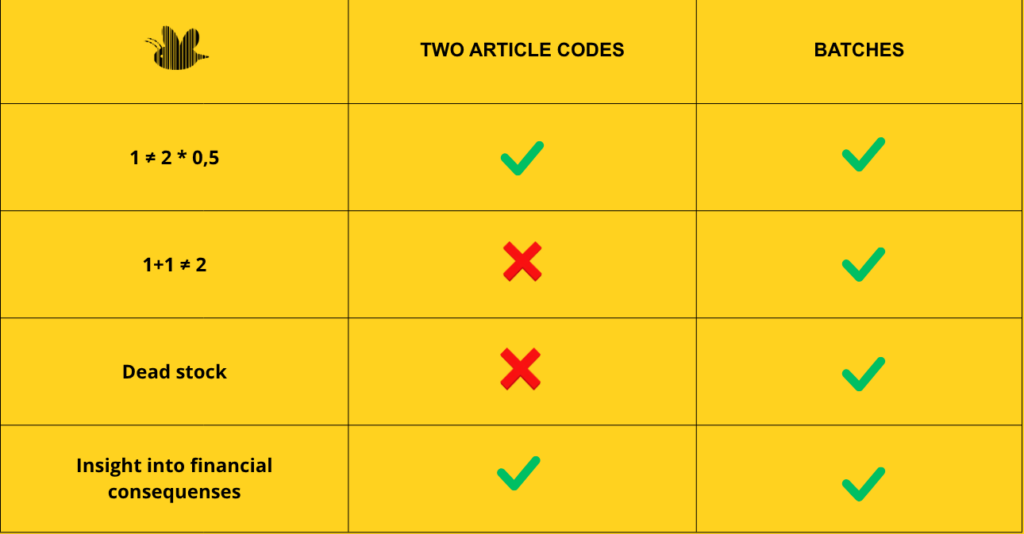
1 ≠ 2 × 0,5
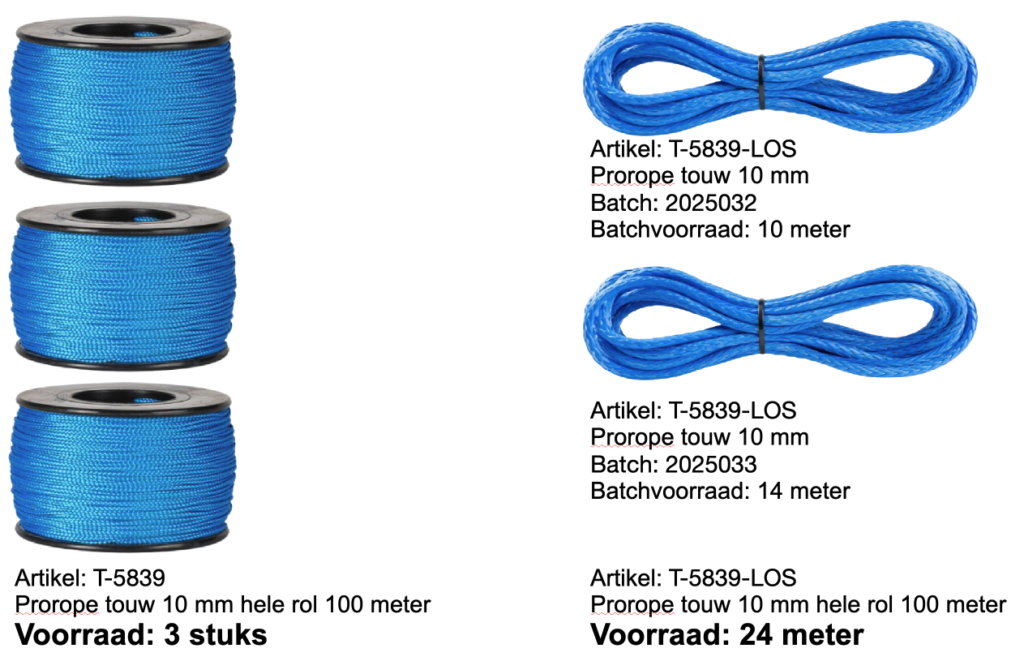
If, for the sake of simplicity in your bookkeeping, you choose to record only one item, you will have to sell part of a roll when selling by the metre. With a stock of three rolls of 100 metres and three sales of 60 metres, will still be 1,2 rolls left over. Nowhere does it state that these are three pieces of 40 metres and that the whole rolls are sold out.
1 + 1 ≠ 2
If you use two item codes for whole rolls and ‘rolls in individual metres’, over time you will be able to see how many individual metres are left in stock, but not how many pieces that stock consists of. There may be 100 metres in stock, whilst this might actually be ten pieces of 10 metres each.
The creation of remaining stock
Sales data can be used to determine the minimum length sold over the past five years. If there are remnants in the warehouse that are shorter than this length, then it is likely that they will never be sold . These remnants will then remain in stock.
No insight into the financial consequences
If there is only one item, it is not possible to apply a price mark-up when selling by the metre. Cutting waste and unsaleable offcuts may therefore not be factored into the price.
How to solve it?
The four problems mentioned must be addressed in a simple and logical way. This requires two changes to the work process.
1. The whole roll has a different code to the individual metres
It is standard practice to use one item code for the entire roll and a different one for sales by the metre. When a whole roll needs to be opened to sell individual metres, the entire roll is written off and the equivalent in individual metres is written on. This can be done using a counting transaction. By creating two separate items, the financial implications of splitting the roll can be resolved by making the ‘individual metres’ item more expensive than the whole roll. By creating two separate item codes, you also maintain visibility of the whole rolls and thereby resolve the ‘1 ≠ 2 * 0.5’ issue.
2. Items sold by the metre are batch items
Simply using a separate item code does not solve the problem. Ultimately, you’ll be left with unsellable ‘loose ends’. To resolve this, the ‘loose metres’ item must be entered as a batch item, allowing you to track stock levels on a per-batch basis.
When writing off a whole roll and posting individual metres, a batch code must be specified where the number of metres equals the length of the whole roll. As metres are sold, the ERP system automatically tracks the remaining length.
When creating a picking list, in the case of individual metres, the system can now automatically search for the batch with the shortest length above the required length; if such batches no longer exist, a warning can be issued that a whole roll must be converted into individual metres.
If the batch length is shorter than the minimum length sold in recent years, a ‘dead stock’ item (unsaleable stock) is created.
This resolves the issues of ‘1 ≠ 2 * 0.5’ and ‘dead stock’.
Supported by Be-Efficient
The standard Be-Efficient package includes a number of applications that support the ‘pieces & parts’ process. These help to provide a clear overview of stock levels and help prevent slow-moving stock from building up.
Whole-2-parts
The ‘parts’ item has been recorded under the ‘whole roll’ item, along with the quantity in pieces or metres. By scanning the ‘whole roll’ item and confirming the conversion, the whole roll is written off. The item with the quantity of individual parts is then written on.
Procedural change regarding import orders
If a customer wants two 25-metre lengths, this must be entered on two separate lines.
Modification to the pick list generator
Once the business rules are known and the correct batch item has been selected, this can be incorporated into the picking list generator. If ‘smallest suitable batch’ is selected, the picking list automatically selects the smallest batch with which the order can be fulfilled. Another option is ‘smallest suitable batch – with minimum remaining length’, which helps to prevent dead stock.
The dead stock query
If the remaining length on the roll falls below a certain minimum (the lowest sales length over the last three years), this batch will be highlighted in Be-Efficient’s retail subsidiary alert system.